Painless Dental Implants: Modern Anesthesia Options
Fear of surgical pain prevents millions of individuals from replacing missing teeth and restoring confidence in their smiles. However, modern dental medicine has transformed oral surgery into a routine, comfortable experience. If you are seeking painless dental implants, contemporary anesthetic protocols now completely eliminate surgical discomfort. At SN Healthcare Multan, located at Raheem Chowk on…
Fear of surgical pain prevents millions of individuals from replacing missing teeth and restoring confidence in their smiles.
However, modern dental medicine has transformed oral surgery into a routine, comfortable experience.
If you are seeking painless dental implants, contemporary anesthetic protocols now completely eliminate surgical discomfort.
At SN Healthcare Multan, located at Raheem Chowk on Masoom Shah Road, patient comfort remains our ultimate standard of care.
Asst. Prof. Dr. Shahzad Hussain, our Lead Consultant Maxillofacial and Dental Implant Surgeon, utilizes state-of-the-art pain control techniques.
Whether replacing a single missing tooth or restoring an entire dental arch, modern anesthetics ensure complete surgical control.
Patients who choose dental implants in Multan at our clinic experience stress-free treatments without anxiety.
This comprehensive guide explores how advanced local anesthesia, sedation options, and computer technology make modern implantology painless.
What Are Painless Dental Implants? Modern Anesthesia Explained
Painless dental implants refer to surgical tooth replacement procedures performed under advanced local anesthesia, targeted nerve blocks, or conscious sedation. These modern techniques completely block pain signals during placement, ensuring maximum patient comfort, minimal tissue trauma, and a predictable, stress-free surgical experience.
Many patients naturally assume that inserting a titanium post into jawbone causes severe surgical pain.
In reality, jawbone tissue contains very few sensory nerve endings compared to outer gum tissue.
Once a dental surgeon completely numbs the surrounding soft tissues, the surgical procedure becomes entirely painless.
Modern painless dental implants rely on precision pharmacological agents that temporarily interrupt peripheral nerve transmission.
By blocking sodium channels in sensory nerves, localized anesthetics stop pain signals from reaching the central nervous system.
This physiological block guarantees that you feel absolutely no sharp pain or severe discomfort during implant placement.
Surgeons tailor anesthetic dosing specifically to each patient’s anatomical structure, procedure length, and physiological profile.
Understanding these mechanism-based approaches reassures anxious patients that surgical treatment will remain comfortable.
Anesthesia and Sedation Options for Painless Dental Implants
Selecting the ideal anesthesia protocol depends on your clinical complexity, medical history, and personal anxiety level.
During your preliminary consultation at SN Healthcare Multan, Asst. Prof. Dr. Shahzad Hussain designs a personalized pain management strategy.
We offer a full spectrum of surgical pain control techniques tailored to your individual dental needs.
Local Anesthesia Protocols for Painless Dental Implants
Local anesthesia serves as the foundational technique for routine implant surgery and minor bone grafting procedures.
Surgeons administer buffered anesthetic solutions like Articaine or Lidocaine directly around the targeted implant site.
These advanced solutions penetrate deep tissue quickly, delivering profound numbness within minutes.
Surgeons often combine localized numbing agents with epinephrine to constrict micro-vessels in the surgical zone.
This vascular constriction reduces localized bleeding and significantly prolongs the anesthetic effect during surgery.
As a result, patients receiving painless dental implants remain fully awake and completely comfortable throughout the entire procedure.
Conscious Sedation Dentistry Multan
For patients suffering from severe dental phobia or heightened surgical anxiety, local anesthesia alone might feel overwhelming.
We provide specialized sedation dentistry Multan services to help nervous patients relax deeply during treatment.
Conscious sedation keeps you awake and able to respond to commands, yet totally free from emotional stress.
Inhalation sedation uses nitrous oxide gas delivered through a small, comfortable nose mask throughout your visit.
Oral sedation involves prescribed anti-anxiety medications taken shortly before your scheduled surgical appointment begins.
Both options elevate your pain threshold, relax muscular tension, and suppress dental anxiety effectively.
Intravenous (IV) Sedation & Deep Surgical Control
Intravenous sedation delivers anti-anxiety medications directly into the bloodstream for immediate, controlled relaxation.
Maxillofacial surgeons frequently utilize IV sedation for full-arch reconstructions, multiple implants, or complex jaw bone grafts.
Under IV sedation, patients drift into a state of deep relaxation and retain almost no memory of the procedure.
Comparing Anesthesia Options for Dental Implant Surgery
Evaluating different anesthetic methods helps patients select the most suitable approach alongside their surgical specialist.
The comparative table below outlines the key attributes of each sedation option available at our Multan facility:
| Anesthesia Type | Primary Indication | Patient Awareness Level | Recovery Time | Surgical Pain Control |
|---|---|---|---|---|
| Local Anesthesia | Single or simple dental implants | Fully awake & responsive | Immediate (1-2 hours) | 100% Localized Numbness |
| Nitrous Oxide (Inhalation) | Mild dental anxiety & single implants | Awake, deeply relaxed | 15-30 minutes | Enhanced Comfort & Pain Block |
| Oral Sedation | Moderate dental phobia & routine surgery | Drowsy, easily aroused | 4-6 hours | High Relaxation & Numbness |
| IV Sedation | Complex full-mouth implants & bone grafts | Twilight sleep / Semi-conscious | 12-24 hours | Total Amnesia & Pain Control |
How Technology Enables Painless Dental Implants
Surgical techniques have evolved dramatically over the past decade through digital dentistry and 3D imaging.
Traditional implant surgery required larger incisions in the gum tissue to visually inspect the underlying jawbone.
Today, computer-guided surgical technology drastically reduces physical tissue trauma and shortens overall surgical time.
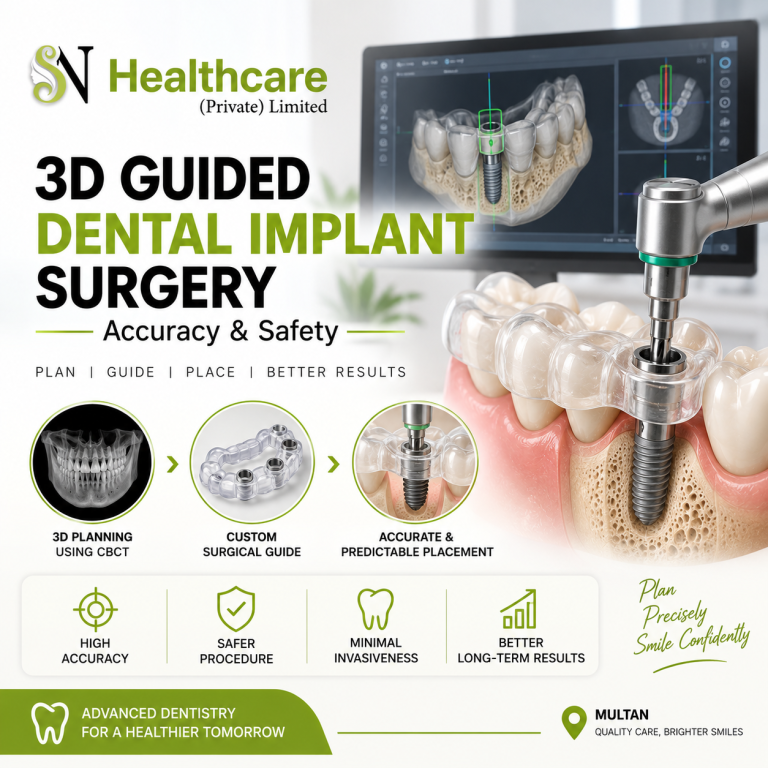
By utilizing high-resolution Cone Beam Computed Tomography (CBCT) scans, surgeons map out your exact neural anatomy.
We create precision surgical templates that allow flapless implant placement without extensive gum incisions or heavy suturing.
To learn how digital planning minimizes operative trauma, read our guide on Computer-Guided 3D Implant Surgery: Accuracy & Safety.
Flapless guided surgery preserves peri-implant blood supply and minimizes post-operative inflammation significantly.
When surgical trauma is reduced, patient comfort increases, making the entire journey toward painless dental implants effortless.
Digital guides also ensure accurate post placement, eliminating unnecessary pressure on adjacent natural teeth and soft tissues.
Post-Operative Pain Management and Recovery Protocols
While effective anesthesia eliminates discomfort during surgery, controlling post-operative healing remains equally critical.
Most patients report that post-implant discomfort feels significantly milder than the recovery following a tooth extraction.
With proper pharmacological support and self-care, post-surgical pain remains minimal and easily manageable at home.
Asst. Prof. Dr. Shahzad Hussain prescribes targeted anti-inflammatory regimens to neutralize tissue swelling right after surgery.
According to clinical research published on PubMed, non-steroidal anti-inflammatory drugs (NSAIDs) combined with acetaminophen provide superior analgesia compared to narcotics.
Following strict pre-operative and post-operative protocols ensures rapid tissue regeneration and comfortable bone integration.
To review detailed recovery guidelines, explore our clinical overview on How to Manage Pain & Swelling After Dental Implant Surgery.
Additionally, standard safety recommendations provided by the American Dental Association emphasize gentle oral hygiene and prescribed cold therapy during the initial 48 hours.
Choosing expert care for dental implants in Multan ensures long-term surgical success without unnecessary discomfort.
Painless Dental Implants at SN Healthcare Multan
At SN Healthcare Multan, we prioritize your emotional peace of mind alongside your oral health.
Located at Raheem Chowk on Masoom Shah Road, our modern surgical facility features clinical-grade sterilization and modern diagnostic technology.
Our clinical team understands patient fears and designs customized treatment plans prioritizing patient comfort.
Asst. Prof. Dr. Shahzad Hussain brings extensive maxillofacial surgical expertise to every complex implant procedure.
His academic leadership and surgical precision ensure that every patient receives painless dental implants under strict safety standards.
From initial CBCT consultation to final crown placement, our staff guides you gently through every phase of treatment.
Do not let the fear of surgical pain prevent you from restoring your natural smile and bite functionality.
Experience gentle, state-of-the-art implant dentistry tailored to your unique anatomical and emotional needs today.
Ready to transform your smile painlessly? Schedule your expert consultation and contact SN Healthcare today.
Frequently Asked Questions About Painless Dental Implants
Do painless dental implants hurt during the procedure?
No, dental implant surgery does not hurt during the procedure. Modern local anesthesia and targeted nerve block techniques completely numb the surgical site. Patients feel slight tactile pressure during post placement, but experience no actual surgical pain.
What type of anesthesia is best for dental implant surgery?
Local anesthesia works exceptionally well for single or simple dental implant placements. However, patients with severe dental phobia or those undergoing full-arch restorations often benefit from IV sedation or oral conscious sedation for enhanced emotional comfort.
Is sedation dentistry safe for anxious patients in Multan?
Yes, sedation dentistry is safe when administered by qualified maxillofacial professionals. At SN Healthcare Multan, Asst. Prof. Dr. Shahzad Hussain monitors patient vital signs continuously, ensuring absolute safety and comfort throughout the entire surgical treatment.